I used a log book for the majority of my life, but inconsistently. I’ve been using the Glooko app for the past two years with my Freestyle Lite meter, I just upload my readings, I can add in exactly what I ate, it syncs with my fitness trackers so I can see when I did exercise.
Like many other people, I find the visual guide in terms of graphs invaluable in terms of seeing the trends in my BGL.
Since getting my G5, I’ve also been using Diasend as it seems to deal with the CGM data better than Glooko. THough unfortunately Diasend does not have the same level of customisability with food diaries as Glooko.
Both companies recently merged though so I’m not sure what their future plan is. Hopefully one awesome super application!
This thread started at a good time for me since I’m feeling a little blah about tracking stuff these days. I was very thorough keeping logs until I got my CGM, though I am meticulous about entering bolus, carb, health, and exercise data. I also review my CGM reports but not as often as every 2 weeks. (I did a printout for my doc once and asked her to put it in my chart–she was a bit surprised but did so.) I think some additional record-keeping will help me get back where I want to be BG-wise.
I also downloaded and modified the exercise log from The Fit Blog and I think that will be helpful. I realize that I exercise reactively more often than not, i.e., to knock down a high BG. I do plan for the carb demands of yardwork, housework, and yoga class pretty well. Now that winter weather is coming, I am going to plan aerobic exercise (elliptical) into my days more carefully.
Tossing in another vote for mySugr (totally biased – I work there). We’re working hard to automate as much as possible because manual logging is so 2015.
I love that we have many great options to choose from!
My endocrinologist loves me because when I come in for an appointment, I have not only the OmniPod’s logs, but also my personal log which I enter on the Diabetes Connect (DiaConnect) app on my iPhone. I love the app because it easily lets me track dates, times, carbs, bolus, correctional insulin, change in basal rates, weight, and sports. I also can add labels and notes, and it even lets me add reminders. The app provides graphs, statistics (nice to know what my calculated A1C is at all times!), and the ability to print or export this data to others. Seeing trends in how daily activities, meals, and insulin helps me make intelligent changes, and if the trend is going in the wrong direction, I know what to do. Being responsible about my numbers has allowed me to live a full, almost normal life where diabetes has an influence on but not control of my daily living. Logs are a must for me to being self-aware and proactive to create the life I want to live.
I am on MDI and without CGM but I use an app that my meter syncs to. It allows me to enter relevant notes to my readings and stores it in a cloud.
My most important log, though, is a whiteboard in my kitchen (or the notes in my phone when I’m out). I track meals (amount, type and time), pre-meal BG and bolus units. This info I erase at the end of each day. It shows me changes in my IR and also if there is any IOB at any given time.
Additionaly, I track my basal units in a cycle chart along with basal temperatures and 2 a.m. BG. This has really helped me in adjusting my basal insulin when hormones shift.
It looks like it’s your body’s basal temperature (I suppose “basal” because it’s your background temperature when you’re not sick?). It looks like it’s a way to track what female hormones are doing, as the temperature rises by 0.5 to 1.0 degrees F the day after ovulation. It’s usually used by people who are trying to conceive, but I think this sounds like a really good idea as a heads-up for when major increases in insulin might be in store…
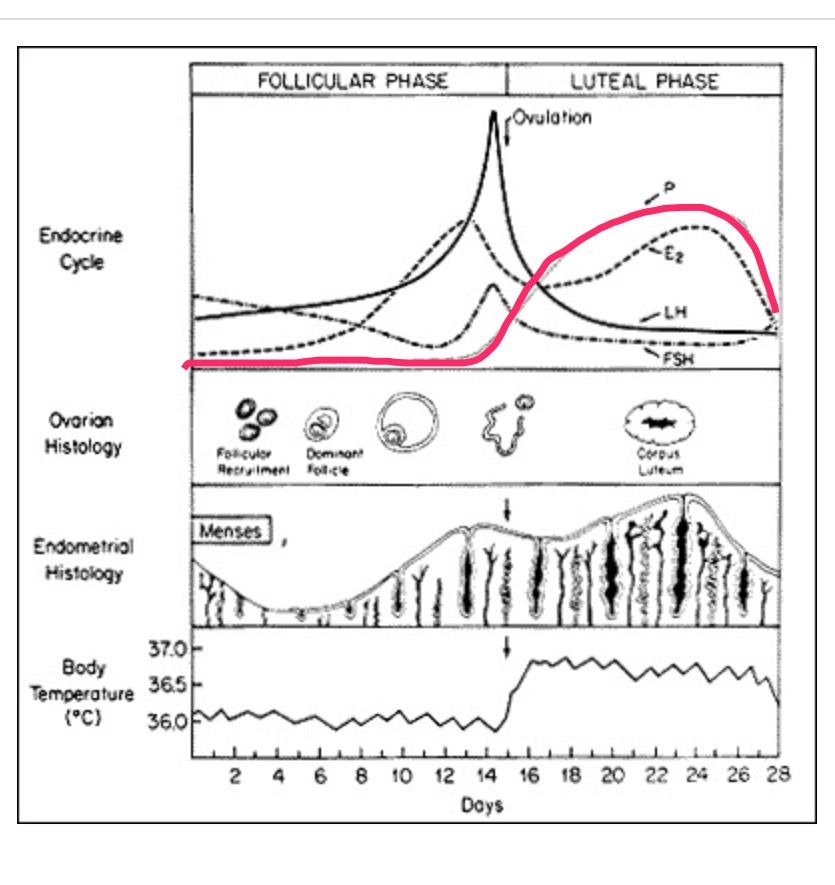
Oh sorry, I see how that could be confusing. I track my resting, i.e. ‘basal’ temperatures as one of two ovulation markers, this is known as sympto-thermal charting. Progesterone rises in women after ovulation until menses. But you cannot predict ovulation. Being an endocrine event it can be thrown off and delayed so I can’t adjust my insulin just by looking at a calendar. Ovulation can be confirmed by either ultrasound or by temperature shift. Progesterone is the ‘warming hormone’ and raises basal temperatures (see graph below) but it can also mess with insulin response depending on its proportion to estrogen. So I log both, my basal insulin units and basal temperatures to know when I have to adjust my Lantus. The pink dots in my chart (in my previous post above) are my basal temperatures. My 2 a.m. BG plus my Lantus units taken are logged in the notes and appear written across each day.
The red line in this graph shows progesterone action and below you can see the low temperatures associated with the pre-ovulatory phase and the high level associated with progesterone action after ovulation (luteal phase).
Not a typo at all! It looks like you understand this overlaying hormonal cycle well. It makes my male insulin/glucose game look simple by comparison! Thanks for the detailed explanation.
I’m glad you posted! I think it’s a really good idea, and am going to start trying it as a strategy. One of my biggest struggles in keeping tight control are the rapid insulin adjustments caused by hormones, and the fact that (as you note) dealing with it is not as simple as marking a day on the calendar.
Actually, tracking basal temperatures is also one way of monitoring your thyroid. There is some controversy on it’s utility. I had some really funky stuff going on at one point and my basal temperature dropped to 95 degF.
Let me know, Jen, if you need any help. I am a charting instructor. Just message me if you like!! If you are ovulating, you should still see a shift even with thyroid issues. Your ranges might be different, though. Basal temperatures can be elusive to collect because they react to many factors but once you track them for a while you can see what things mess them up. (It’s kind of like blood sugar:roll_eyes:…)
Thanks! I plan to do some research and get set up with whatever tools I need this weekend. I feel like if I could get the hormonal changes figured out I’d have a much better shot at tighter control, so any tool that might be able to help is good!
Today was “drop day” for me, when all the insulin resistance of the past two weeks suddenly disappears all at once. So I go from battling constant spikes to eating 60-75 grams of carbs with no Bolus this morning to keep by blood sugar up. Even decreasing all my pump settings dramatically this morning didn’t seem fast enough to prevent the persistent lows. The only good thing is that at least I know once I get pump settings re-adjusted the next week or two will be easy for a while! (Now low again after taking this picture!)
I’m not on a pump but I am recently diagnosed T1.5, so I’m on a combo of shots and orals, and I need to test a lot, so I created a detailed spreadsheet where I keep track of the amount of all meds and the readings throughout the day. I also have a column that averages the day, which isn’t incredibly scientific but it works for visualization. I also have a column where I put quick notes, like if I had a big meal or forgot my pills or something, or if I felt a certain way. I also “split” the sheet for each timeframe in between Endo visits, so it makes it even easier to read and understand. While not a necessity, I find it to be a helpful companion to just the meter. I also have a small chart imbedded in the second spreadsheet that I log my A1c results and the dates of each test.


 [/URL]

 If you are ovulating, you should still see a shift even with thyroid issues. Your ranges might be different, though. Basal temperatures can be elusive to collect because they react to many factors but once you track them for a while you can see what things mess them up. (It’s kind of like blood sugar:roll_eyes:…)