Why is my BG going up after taking insulin?

Sometimes I skip or delay lunch and my BG will start creeping up. I try to take a small dose of novolog to correct but that makes my BG rise. Is there some counter-regulation thing going on? It is consistently related to either time since last eating and/or time since last bolus. Since I know it is going to happen I can increase the correction dose but there is a super fine line between big enough and crashing because I have no carbs on board.

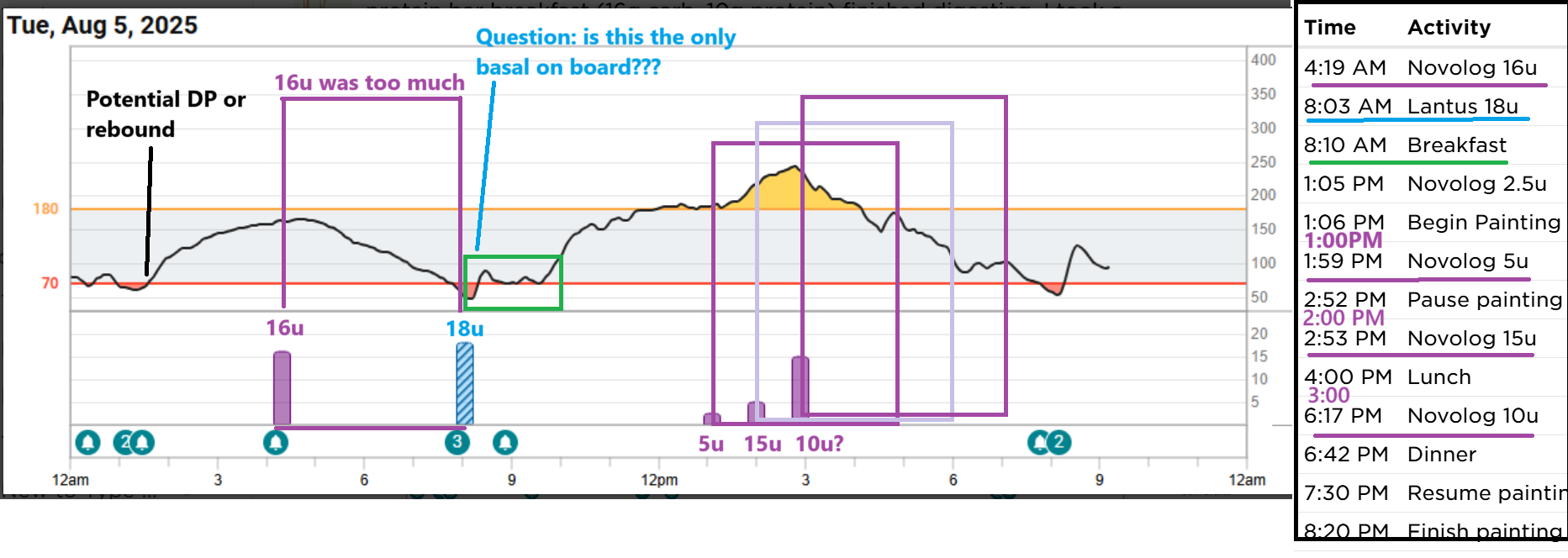
Here’s an example from this week. I spent the morning at the computer so no exercise and I failed to notice my dawn phenomenon bolus had run out before my protein bar breakfast (16g carb, 10g protein) finished digesting. I took a correction but didn’t add anything because I was going be active. Not cardio induced blood sugar rise active but walking/lifting/doing those poses on the ladder warning label active. An hour later I’m still high so I bolus again and do not correct for IOB or activity. Another hour and I see I’m still going up and the rate of rise has increased. I meal bolus, wash up the paint brush and have lunch at 4pm. What the heck is going on between 1 and 3pm?

Time Activity Glucose
4:19 AM Novolog 16u 164 mg/dL
8:03 AM Lantus 18u 53 mg/dL
8:10 AM Breakfast 49 mg/dL
1:05 PM Novolog 2.5u 186 mg/dL
1:06 PM Begin Painting 186 mg/dL
1:59 PM Novolog 5u 215 mg/dL
2:52 PM Pause painting 238 mg/dL
2:53 PM Novolog 15u 238 mg/dL
4:00 PM Lunch 90 mg/dL
6:17 PM Novolog 10u 120 mg/dL
6:42 PM Dinner 78 mg/dL
7:30 PM Resume painting 128 mg/dL
8:20 PM Finish painting 84 mg/dL
1 Like

I’ve seen this too. Wondered if it is increasing insulin resistance. But I don’t know the real answer.

1 Like

I believe it is a hypo bounce back.

When you go low, your liver dumps glycogen to counteract the low and sometimes it happens later than you think. and sometimes it doesn’t know when to stop.

This is how the roller coaster thing happens.

Yes there is always a feeback loop when it comes to blood sugar

I have AN EXTREEM predwn spike that happens at 330 am. And then isn’t much I can do about it unless I wake up to take a bolus, as my pump can’t really handle it with just basal corrections.

Does your pump use basal insulin? I was told that pumps only use bolus insulin…the one the endo is pushing it Bionic i Let. Your pump cannot handle the dawn spikes?

I see this even when I’ve been at 90 for 8 hours. I’m not saying it’s not a factor but what does it set up that causes my BG to go up when bolusing.

the DP is next weeks question :grin:

@Andrea8 MDI

Yes pumps handle dawn phenom and yes pumps do both bolus and basal.

I’m on an omnipod now and it doesn’t handle my spike well at night. It comes down eventually, but when I was on my tandem, it did a better job. But that’s a long story why I’m on omnipods now.

Tandem will give an automatic bolus, and omnipods don’t. Which makes it less effective in that situation,but overall the omnipod is pretty good

Sounds like a liver glucose dump from going too long without food/insulin, plus timing issues. Smaller, earlier corrections or pairing insulin with a tiny snack can help avoid the highs and crashes

Thanks @Laurengratte. I asked my question poorly and updated the post to fix that. I’m asking about what happened between 1 and 3 pm. I know exactly how I got to the 180s. I’m asking for help with why insulin plus activity caused me to go higher. If you can take another look I’d appreciate it.

thank you SPDIF for referring me to that TCOYD YouTube podcast. Three years never have heard of this never been mentioned by medical personnel and it’s been around 30 years.

Three different dietitians never mentioned it as a resource and two Endos. Especially focus on type one is helpful.
1 Like

I think the basal is too low. I’ve been having similar Problems this week, but I’m not going to change my basals because I think its going to go back to normal next week. I’ve been correcting my way out of it and the amount of correction I need to deliver has been over the moon (like 15 units). Those slow increases start to look like pump failures. I was wondering if the insulin went bad in the heat, but MI has been working fine.

1 Like

Don’t be too hard on your care team. I’d be wary of recommending resources on the internet if I were in their shoes. The ratio of facts to crazy is terrible. If you tell them about the site also mention TCOYD has a way to earn a continuing education unit (CEU) to make it worth their time. Everyone in diabetes, patients and docs, are always learning.

Now, I’m going to go outside to look for the flying pigs because I just defended healthcare and that is weirder than taking insulin and having my BG go up.

I went to that TCOYD website and they had the presentations listed, but there was no video to watch. It was to show if you had registered to go to it, but I did listen to a podcast and maybe I can find that one on the pumps on the podcast. thanks for the tip, but there was no way that I could figure out to see the presentation by video. It was just listed if you were registered for the conference..

Your numbers are good. I wouldn’t change the basal dose unless you see difficulties consistently over a number of days. Of course, you know that you are stacking insulin between 1 and 3:00. You are over correcting a bit, but the data doesn’t look that bad.

Why aren’t you taking that Lantus before bed so that it kicks in by morning when you need it?

2 Likes

I wish my endo or AI could analyze my data like that! How was that done?

We all can look at your data, @Cevans54 and draw pics for you if you upload it. I’m just screenshotting his data and using Paint to draw on the screenshots. The program called Paint is on every windows computer.

image

I just logged back on to to @spdif that the guys used to always have me split my Lantus like this when I was getting bad DP. I used to get REALLY bad DP on Lantus so they had me do 2 shots - one before bed and one when I woke up.

1 Like

Your MS paint skills are really impressive. Any time I use paint it looks like minecraft. The lantus is okay, its working fine in the days before and ever since. The dose absolutely could use some fine tuning but that’d only make a difference of maybe +/- .1u/hr.

I was absolutely stacking and taking into account the IOB at each dose. Going from an increase of .5mg/dL/5min to 2.6ish called for action. I originally said the rate increased, doing the math I see it didn’t. Rate of change is my second #1 Dexcom feature request.

I’m not ignoring your DP comments, like I said to Timothy that’ll be another post because it isn’t part of this question and it is the giant sucking sound in my diabetes management at the moment and my endo’s contribution so far is to offer literally nothing when I ask about it. My next appt got pushed 2 months, if she doesn’t offer something when I ask about DP again I’m gonna have to find someone out of network.

1 Like

What a good puzzle you’ve given us, Chris. You ask specifically what’s up between 1-3pm. Painting might be a big part of it. Were you painting on canvas or outside, in heat, on a high ladder? Stress hormones could be at play (like with weightlifting) causing a rise. Information that would be helpful is if you are giving one dose of Lantus a day or splitting the dose. It’s trickier to do with MDI but the smoother the absorption of basal insulin, over all 24 hours, the better. I’m a huge advocate of basal being spot-on and the first point to address when troubleshooting volatile, seemingly unexplainable blood glucose levels. Best of luck. Oh, one more thing, the new Dexcom app now allows for photos of your meals. This could be helpful information to have as timing the insulin dose to the carb/fat/protein matters. Writing summaries of meals is tedious but a photo is easy and durable evidence.

No one is better than me in paint. LOL.

Yup.

I have a different take.

I think your basal might be too high or boluses might be off. On your 24 hr chart, you have 3 hypos. One of them is after taking 16u of Novolog without eating anything, for dawn phenomenon, I presume. Then by breakfast, it go down to 50 mg/dl. You eat and take your Lantus. Your bG bumps up a little, then goes back down. That’s probably mostly from the Novolog, as the Lantus is only just starting to kick in, if that. Then it barely get up to 100 before it starts down again. It should go up to 120-140 60-90 min after your meal.

Q: how often does your bG go low at 9-10am? On this one day it’s kind of borderline.

It looks like you’re trying to cover DP with Novolog. Another way might be to split your Lantus in to 2 doses, 12 hours apart. Your DP may actually be the Lantus trailing off. Splitting the Lantus would put 4am more in the middle of a Lantus curve. You might be able to reduce or even eliminate the nighttime Novolog.

The evening low could be from not eating enough to cover the activity. Or maybe to having too much Lantus onboard at that time. Another advantage of splitting the Lantus, you vary the doses a little to take care of varying basal requirements through the day.

With three lows in 24 hrs, you could be in rebound for a lot of that time. If your insulin is adjusted to take care of that, there might be a gap in the time frame that you’re bG went high. Here is a review of counterregulatory hormones to inform adjusting insulin.

Counterregulatory hormones are glucagon, epinephrine, cortisol and growth hormone. They’re also know as stress hormones. In times of stress, ie threat, they increase glycogenesis in preparation for fight or flight. They kick in at different bG levels and last varying lengths of time.

Glucagon triggers glycogenesis from the liver by converting glycogen to glucose and releasing it.

Epinephrine (adrenaline) causes most of the physical symptoms like sweating and shaking. The more frequently one experiences that, the lower the level of secretion. This is what cause hypoglycemia unawareness.

These hormones can continue to be released/active up to 24 hrs after the low. I was taught to not make insulin adjustments to highs that happen within 24 hrs of a low. Adjust to eliminate lows first. Some, maybe many or all of the highs will go away too. Make further adjustment, if necessary to take care of any remaining highs.

Talk ALL of this over with your Endo. Consider getting a insulin pump. Read the book Pumping Insulin by John Walsh and Ruth Roberts.

Good question, I should have said once a day. Just got done trying split dosing for a month. It proved that I’m “normal” and Lantus lasts 22-23 hours for me. Same as when I tried it 5-ish years ago. On the day shown I was re-painting the top of a 7’ fence. Ladders are my happy place, I was a stagehand for ten years starting in HS, I spent a lot of time imitating the stick figures on the warning labels so being up a ladder makes me feel like a kid again. No stress. Enough exercise, combined with that amount of basal, every other day of the week lowers my BG. Beautiful weather, the pause happened because it got to 86F and the paint was drying on my brush.

Instead of getting deep in the specific example I’m trying to work the general case for the puzzle.


I take basal, bolus, eat breakfast. The important part is I skip lunch. BG starts trending up, I take a correction to stop it and my BG goes up faster. The correction dose is the correct amount if this was a normal 3 meal day. This question isn’t about dosing or management. I’m wondering why the physiological reaction to insulin in this particular situation.

1 Like